
What Risks Must Cleanroom Air Filtration Control?
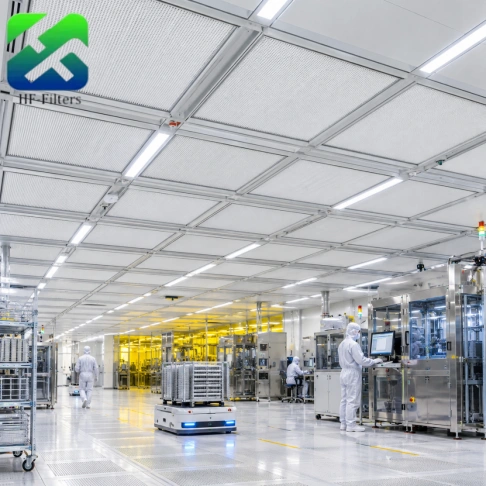
Define cleanroom air filtration for electronics manufacturing with a contaminant map. Electronics, PV, battery, and GMP-controlled rooms set different limits. In Vietnam or Indonesia projects, confirm imported filter dimensions, test data, and replacement timing. Use the ISO particle-classification standard to set the room class.
Particle Contamination and Room Class
HEPA captures particles that settle on wafers, cells, or boards. Set H-class by room design and test standard; confirm airflow, seals, and housing fit.
Airborne Molecular Contaminants
Process air can contain airborne molecular contaminants such as acids, bases, and organic compounds. Identify target gases before choosing AMC filter media.
How Do HEPA and Chemical Filters Work Together?
Set cleanroom HVAC filter stages by air path. A typical train puts prefilters and pocket filters upstream, HEPA at the designed supply terminal, and chemical media where target gases enter.
Filter Stage Comparison
| Stage | Trabajo principal | Check Before Selection | Usual Position |
| Prefilter or medium-efficiency pocket filter | Capture dust and reduce downstream loading | Grade, airflow, pressure drop | Upstream |
| H13 or H14 HEPA filter | Capture particles to specified efficiency | Room class, test standard, airflow, seal | Designed supply or recirculation stage |
| Chemical filter | Sorb selected gases | Gas, concentration, humidity, service interval | Intake or return-air point |
H13 and H14 HEPA for Particle Control
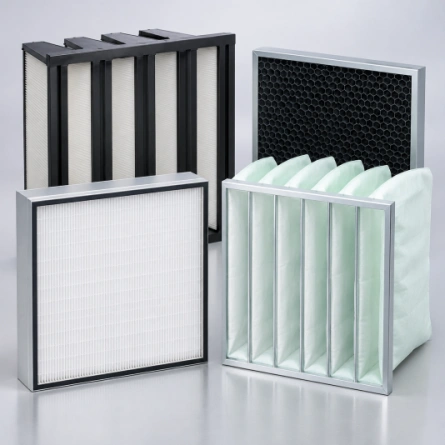
Choose a HEPA filter for cleanroom supply by room target and rated airflow. One H13 V-bank measures 592 × 592 × 292 mm, with 3,200 m³/h airflow and 240 Pa initial resistance. Check model data at design airflow using the HVAC filtration guidance. A corrosion-resistant V-bank filter needs frame and seal materials suited to chemical exposure.
Chemical Filters for Selected Gases
A chemical filter for cleanroom service may use activated carbon fiber, carbon felt, or granular media. Match an activated carbon chemical filter to the target gas and conditions. An upstream F7-or-higher stage can reduce dust loading.
Pocket Filters for Intermediate Stages
A medium-efficiency pocket filter provides upstream particle capture across a large media area. Set grade and rated airflow against the system pressure budget, including loaded-filter pressure drop.
How Do You Select a Filter Train for Electronics and PV Cleanrooms?
Build around room class, process, intake, recirculation, and fan pressure. For Southeast Asia cleanroom filtration, include import lead time.
Map Processes and Target Gases
List particles and gases from etching, cleaning, coating, soldering, or battery processes. Provide known gas names and concentrations; these guide media choice and replacement intervals.
Check Airflow, Pressure Drop, and Fit
Record rated airflow, initial and final pressure drop, dimensions, seal, frame material, temperature, and humidity. Confirm fan capacity with loaded filters. Check for bypass at seals and confirm exposed components suit the chemical conditions. Review filtration efficiency with the specified test method.
What Should a Cleanroom Filter Specification Include?
A clear RFQ gives suppliers process conditions and installation limits for media and dimensions. List particle and gas-phase stages separately.
RFQ Data by Filter Stage
- Application, room class, efficiency class, and test standard.
- Rated airflow, pressure limits, dimensions, frame and seal materials.
- For chemical stages, target gas, concentration, media type, and humidity.
Acceptance and Replacement Plan
Request efficiency and pressure-drop data at rated airflow, drawings, seal details, and applicable test documents. Set the change-out limit, replacement schedule, packaging, and delivery window with the HVAC designer.
How Can a Supplier Support Filter Selection?
With process data and housing limits, a supplier can check media, dimensions, airflow, and pressure drop against the filter schedule.
Filter Review for Electronics and PV
For electronics cleanroom filtration, Filtros saludables supplies H13 and H14 HEPA configurations, V-bank filters, synthetic pocket filters, and chemical filters with carbon-based media. The product range covers different airflow and housing requirements. Send the filter schedule, contaminants, and target pressure drop for a configuration review.
Preguntas frecuentes
Q1: Does a HEPA filter remove chemical gases?
A: HEPA media captures particles. Chemical media targets selected gases. Provide gas names, concentration, humidity, and airflow for media selection.
Q2: Should chemical media go before or after HEPA?
A: Place it at the intake or recirculation point that sees the target gas. Use particle prefiltration to reduce dust loading, then follow the HVAC design for terminal HEPA.
Q3: Which grade should an electronics cleanroom use, H13 or H14?
A: Follow the room design and test standard. Compare airflow, pressure drop, seal, and fan allowance for the selected model.
Q4: Can activated carbon media capture acid gases?
A: Performance varies by compound. Some gases call for treated carbon or another sorbent. Share the chemical name and operating conditions when specifying an activated carbon chemical filter.
Q5: What information should buyers request from a supplier?
A: Request the test standard, efficiency and pressure-drop data at rated airflow, dimensions, seals, media type, and applicable test documents. Identify target gases for chemical filters.