
A few years ago, an equipment manufacturer approached us with a problem that sounded simple.
They needed a replacement foam filter.
Not a new machine.
Not a redesign.
Just a filter.
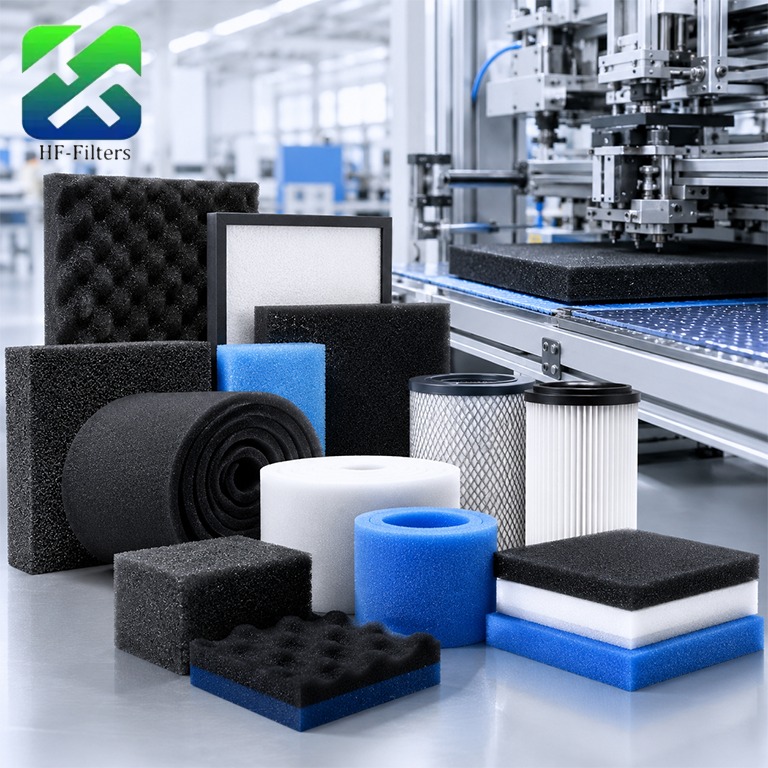
The catch was that every sample they tested either restricted airflow too much or failed to capture enough dust.
On paper, all of them looked similar.
In operation, they behaved very differently.
That’s one reason custom Foam Filter projects are more common than many people realize.
From the outside, foam filtration seems straightforward. A piece of foam sits inside a machine and catches particles.
The reality is a bit more complicated.
A change in thickness can affect airflow.
A change in pore size can affect dust retention.
Even two materials that look nearly identical may perform differently after several months of use.
This becomes especially important when working with Polyurethane Foam.
Different grades of polyurethane foam are used across air purifiers, ventilation equipment, industrial machinery, compressors, and electronic products. Some are selected primarily for airflow. Others are chosen because they can handle heavier particle loads without needing frequent replacement.
There isn’t one universal solution.
The application usually decides what works.
I once visited a factory producing ventilation units for commercial buildings. The engineering team had already finalized the housing design before discussing filtration requirements.
That decision created problems later.
The available space limited the filter thickness, which limited media options, which affected airflow performance.
Eventually they moved to a custom design.
Not because they wanted something unique.
Because the standard alternatives didn’t fit the project.
This happens more often than people think.
In OEM Manufacturing, filtration is rarely an isolated component. It affects airflow, maintenance intervals, energy consumption, and sometimes even product noise levels.
A filter may represent a small percentage of the overall product cost, but it can influence how customers perceive the equipment for years.
That’s why manufacturers are paying closer attention to Filter Media selection than they did a decade ago.
The conversation is no longer just about dimensions.
Questions usually sound more like this:
How much airflow will be lost over time?
How quickly will dust accumulate?
Can the foam be produced consistently across large production runs?
What happens after six months of operation?
Those questions matter because real-world environments are rarely predictable.
A machine operating in a clean office faces different challenges than one installed in a workshop, warehouse, or production facility.
The filter may be the same size.
The workload isn’t.
This is one reason many brands prefer working directly with experienced filtration suppliers during product development.
Companies such as Shenzhen Healthy Filters Co., Ltd., commonly known as Healthy Filters, support OEM projects where standard solutions simply aren’t enough. In many cases, the discussion starts with a drawing or a performance target rather than a finished filter specification.
That’s usually a sign the project requires customization.
And that’s where foam filtration often proves surprisingly flexible.
Questions Buyers Often Ask
Can foam filters be customized?
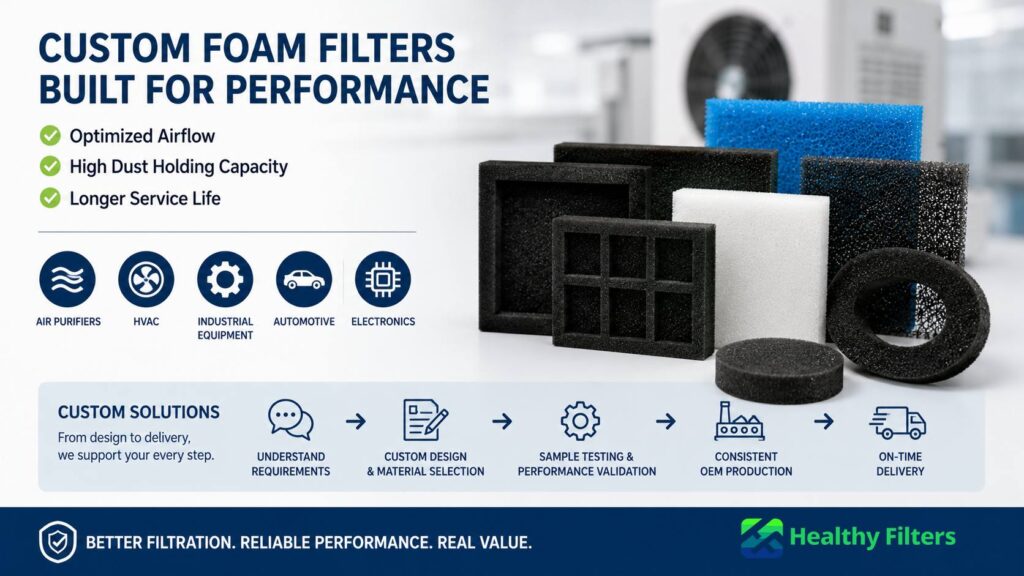
Yes. Thickness, density, pore size, shape, and dimensions can all be adjusted according to equipment requirements.
Why is polyurethane foam used so often?
Because it offers a useful balance between airflow, durability, flexibility, and manufacturing versatility.
Are all foam filters the same?
Not even close. Materials that look similar can perform very differently depending on structure and operating conditions.
What industries use foam filtration products?
Air purification, HVAC, industrial equipment, automotive systems, electronics, ventilation units, and many other applications.
Closing Observation
The most successful foam filter projects rarely begin with the filter itself.
They begin with a problem.
Too much dust.
Not enough airflow.
Limited installation space.
A maintenance issue that keeps coming back.
Once those challenges are understood, the right filtration solution usually becomes much easier to find.