
Most people expect a HEPA filter to fail in an obvious way.
It usually doesn’t.
There is no warning light flashing on the wall. No dramatic change overnight.
What happens instead is much slower.
A purifier that used to feel effective starts becoming part of the background. The machine is still running. The fan is still spinning. Yet something isn’t quite the same.
In the Air Purifier Industry, that’s often how filter life comes to an end—not with a failure, but with a gradual decline.
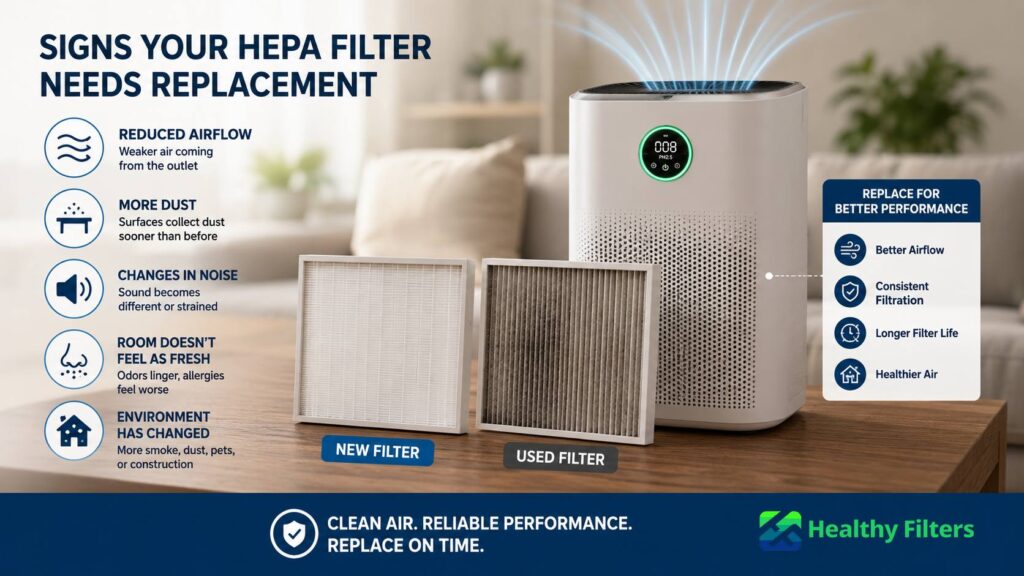
The first sign is usually airflow.
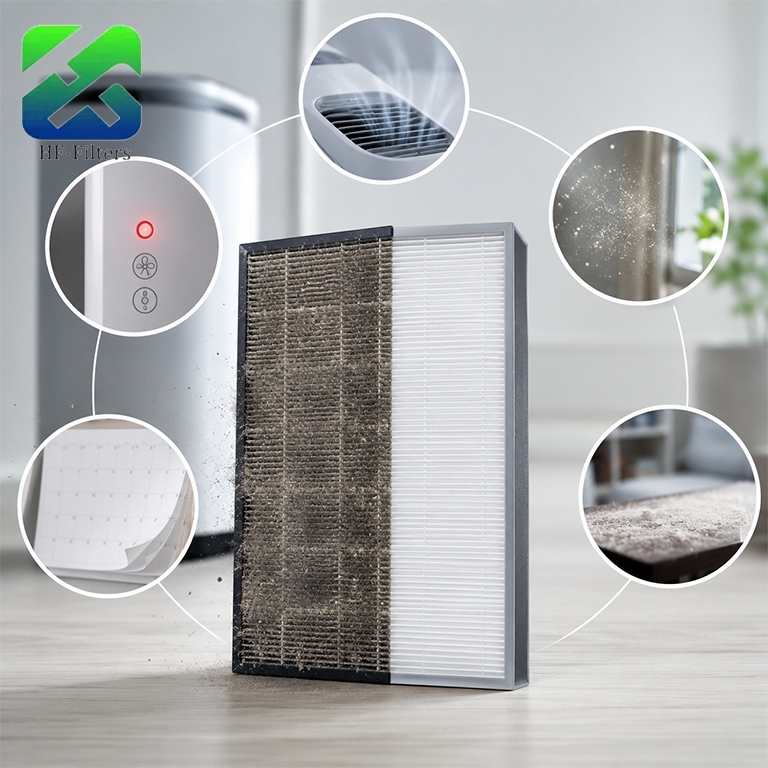
Not enough for most people to notice immediately. Just a little less air coming from the outlet than before. A loaded filter creates resistance, and as dust builds inside the Filter Media, moving air through the system becomes harder.
The purifier compensates.
At least for a while.
Another clue appears on nearby surfaces.
Coffee tables. Shelves. Window ledges.
Dust starts showing up sooner than expected.
Many users assume the purifier has stopped working altogether. More often, it’s simply reached the point where a HEPA Replacement makes more sense than trying to squeeze a few extra months from the filter.
Noise can also change.
Not louder in every case.
Just different.
Fans working against a clogged filter tend to sound strained. Maintenance technicians often recognize the sound immediately, while regular users usually notice only that the purifier seems to be running longer than before.
Then there are the things you can’t measure as easily.
A room that no longer feels as fresh.
Pet odors lingering slightly longer.
Seasonal allergies becoming more noticeable even though the purifier hasn’t changed position.
Those observations aren’t scientific, but they matter. They’re often the reason people check the filter in the first place.
One distributor I spoke with years ago said something interesting.
“Most customers don’t replace filters because they see the filter. They replace them because they feel the room.”
That stuck with me.
Because filtration is ultimately about results, not appearances.
The final sign is one that’s easy to overlook.
The environment changes.
The filter doesn’t.
A purifier that handled everyday household dust perfectly last year may suddenly be dealing with renovation debris, wildfire smoke, increased occupancy, or a new pet.
Same machine.
Completely different workload.
That’s one reason manufacturers continue investing in better Filtration Technology. Air quality challenges don’t stay the same, and filtration systems have to adapt.
It’s also why replacement filter quality matters more than many buyers realize.
A replacement filter may fit physically while performing very differently once installed. Media density, airflow characteristics, and manufacturing consistency all play a role.
Over the years, many air purifier brands have moved toward long-term partnerships with specialized manufacturers rather than sourcing filters from multiple suppliers. Consistency is simply easier to maintain.
Companies such as Shenzhen Healthy Filters Co., Ltd., commonly known as Healthy Filters, have become part of that supply chain for a variety of OEM and replacement filter programs. The focus isn’t only filtration efficiency. It’s making sure the replacement performs the same way the original filter was expected to perform.
That sounds simple.
In practice, it isn’t.
FAQ
How long does a HEPA filter normally last?
It depends on usage and air quality. Some residential filters last six months. Others can remain effective for a year or longer.
Can a HEPA filter look clean but still need replacement?
Yes. Many particles captured inside the filter aren’t visible from the surface.
Will replacing a HEPA filter improve airflow?
In many cases, yes. A fresh filter generally creates less resistance than one that has been collecting particles for months.
Why is replacement filter quality important?
Because not all filter media is produced to the same standard. Differences in construction can affect airflow, filtration efficiency, and service life.
The strange thing about HEPA filters is that most people don’t notice them when they’re working well.
They notice them when they’re not.
And by that point, the replacement is usually already overdue.