
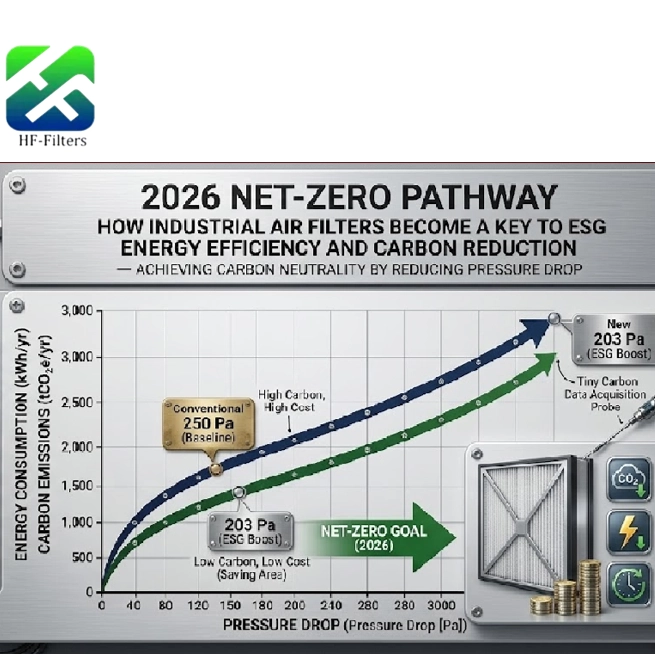
Entering 2026 brings new demands. ESG (Environmental, Social, and Governance) rules now form a core part of business operations. Industrial producers face the push toward Net-Zero. Solar setups and electric vehicle groups draw much attention. However, a practical method to cut carbon releases hides within HVAC and air systems. This approach centers on Low Pressure Drop Air Filtration.
Managing airflow opposition has grown beyond routine care. It serves as a vital element in reaching company-wide carbon balance. Facilities that adopt these changes see clear gains in efficiency and environmental impact. The focus on such filtration helps meet growing regulatory needs.
1. The Direct Link Between Pressure Drop and Carbon Footprint
Industrial sites depend on fans and blowers as essential components. These devices use large quantities of power to force air past filter materials.
The Resistance Problem: Pressure Drop describes the barrier air encounters while moving through a filter. Greater barriers force fan engines to exert extra effort.
The Energy Drain: Increased engine performance results in higher kilowatt-hour (kWh) usage. This rise affects overall power needs directly.
The Carbon Impact: Electricity consumption counts as Scope 2 emissions for many organizations. Cutting the power for air movement reduces the site’s carbon levels. Such steps build a stronger case for sustainability reports.
This connection highlights a simple truth. Small changes in filtration can lead to large environmental wins. Managers often underestimate the role of air systems in total emissions. Yet, data from various plants shows that optimizing Pressure Drop yields quick results in carbon tracking.
2. Engineering the Pathway to Low Resistance
Reaching Low Pressure Drop avoids weakening filtration quality. Rather, it draws on current material advances to uphold strong performance, like HEPA or ISO 16890 levels. At the same time, it clears better routes for air.
Advanced Synthetic Media: Even fiber arrangements trap tiny particles, such as PM2.5. They do this without blocking air passage.
Aerodynamic Pleat Geometry: Carefully shaped folds increase available space. This design lets more air flow at reduced velocities.
Spherical vs. Granular Media: For particle removal, moving to uniform spherical activated carbon from uneven broken types lowers air drag by as much as 30%. This shift cuts down on power loss notably.
Engineers achieve these improvements through targeted design. They test materials under real conditions to ensure reliability. The result combines effective cleaning with smooth operation. Industries benefit from filters that last longer and perform consistently. This engineering focus supports broader goals in energy management.
3. Integrating Filtration into Your ESG Strategy
Companies adapting to 2026 green guidelines shift from basic low-cost filters. They adopt Life Cycle Cost (LCC) assessments instead.
Energy-Centric Procurement: Base choices on running opposition levels, not only upfront costs. For instance, a filter priced $10 higher might save $200 yearly in power. This makes it the better pick for ESG aims.
Predictive Maintenance: Smart sensors for pressure help time replacements accurately. They signal the “Economic Breakpoint,” when energy waste costs surpass new filter expenses.
Green Factory Certification: Using low-resistance options boosts scores in LEED, BREEAM, and similar programs. It enhances the Energy & Atmosphere (EA) section specifically.
This integration strengthens overall ESG efforts. It turns filtration into a tool for compliance and savings. Organizations find that combining these practices leads to verifiable progress. The strategy fits well with long-term planning for sustainable growth. By embedding such measures, sites prepare for future standards effectively.
4. Measurable Benefits for 2026 and Beyond
Switching to strong, low-Pressure Drop setups brings clear advantages for plant managers.
Reduced Operational Costs: Utility payments drop due to fan power cuts of 15% to 25%. These savings add up over months and years.
Carbon Credits & Compliance: Meeting carbon tax rules becomes simpler. It also eases tasks in global ESG documentation.
Enhanced Equipment Longevity: Reduced load on HVAC engines means fewer failures. This lowers spending on replacements in the future.
Beyond these points, benefits extend to worker safety and productivity. Cleaner air with less system strain creates a more reliable workspace. Data from early adopters confirms these outcomes. Plants report not only cost reductions but also improved certification standings. Looking ahead, these upgrades position operations for ongoing success in a low-carbon world. The measurable nature of the gains encourages wider use across sectors.
Conclusion
The year 2026 shapes industry with fresh challenges. Each unit of saved Pressure Drop aids both finances and the environment. Moving to efficient air cleaning stands as a rapid, trackable action toward Net-Zero. Facilities gain from this shift in multiple ways.
Ready to calculate your carbon reduction potential? Reach out to our ESG technical team. They provide a full energy review of your existing filtration arrangement.