
The rapid expansion of AI infrastructure has brought a familiar problem back into focus: keeping cooling systems running reliably is not just about installing more powerful equipment.
For modular and containerized data centers, the air entering the enclosure deserves just as much attention. A site next to a construction zone, an industrial facility, or an unpaved access road can expose intake filters to a much heavier dust load than a typical indoor installation.
The problem often starts small. Dust builds up on the filter surface, airflow resistance gradually increases, and maintenance becomes more frequent. If the filter was poorly matched to the ventilation system in the first place, the consequences can extend beyond the filter itself.
So, when selecting outdoor air intake filters for data centers, what should OEM manufacturers and project engineers look at first?

The Filter That Works on Paper May Not Work on Site
A higher filtration grade sounds attractive, but it is not automatically the right choice for every data center.
Consider a containerized cooling unit operating in a dusty environment. The intake filter needs to capture airborne particles before they reach sensitive downstream components. At the same time, the fan must maintain the airflow required by the cooling design.
Choose a filter with excessive resistance, and the ventilation system may struggle to deliver its intended airflow. Choose one that offers insufficient particle capture, and dust can accumulate further inside the equipment.
This is why filter selection should begin with the operating conditions, not simply the highest available efficiency rating.
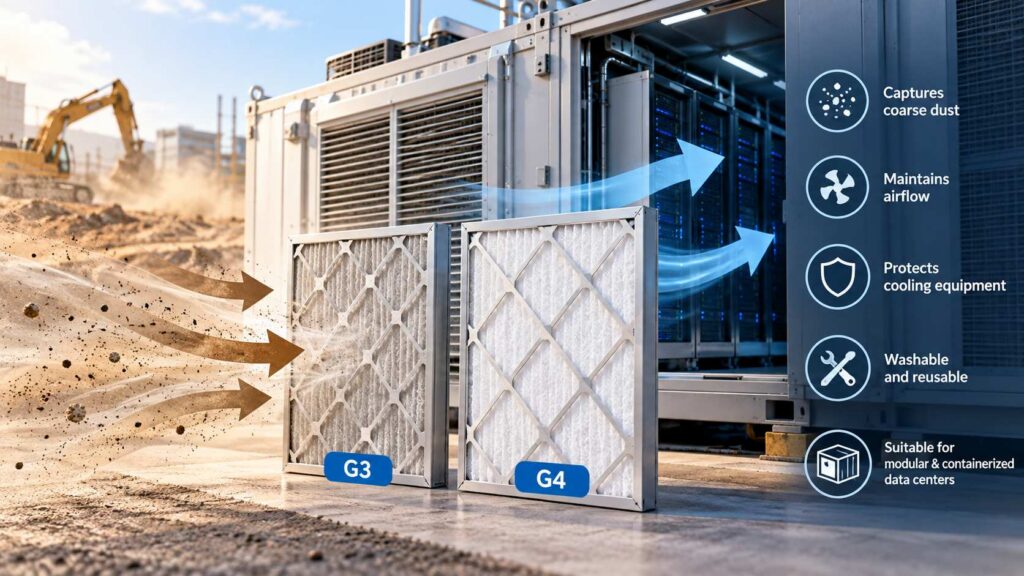
For many primary air intake applications, G3 and G4 panel filters are worth comparing. The final choice depends on the site’s dust conditions, the required airflow, and the pressure drop the system can accommodate.
G3 or G4: Start With Airflow and Pressure Drop
Healthy Filters lists the following specifications for its standard washable G3 and G4 panel filter models.
| Especificación | G3 | G4 |
| Standard dimensions | 595 × 595 × 46 mm | 595 × 595 × 46 mm |
| Flujo de aire nominal | 3,200 m³/h | 3,200 m³/h |
| Caída de presión inicial | 30 Pa | 40 Pa |
| Final pressure drop | 250 Pa | 250 Pa |
| Detención promedio | 85% | 95% |
These figures provide a starting point for comparing the two options. They should not be treated as guaranteed operating values for every installation.
The difference in initial pressure drop is worth noting. At the listed rated airflow, the G3 model starts at 30 Pa, compared with 40 Pa for G4. The G4 model offers higher listed average arrestance, while the G3 model starts with lower resistance.
Neither is automatically better. If the project prioritizes capturing more coarse dust, G4 may be the more appropriate candidate. Where airflow resistance is a major constraint, G3 deserves consideration. Engineers should evaluate both against the actual fan curve and the system’s filtration requirements.
One important detail: average arrestance is not the same as HEPA efficiency, nor does it establish a specific PM2.5 removal rate.
For project-specific dimensions or alternative configurations, see our washable G3/G4 air intake filters for containerized data center cooling systems.
Are Washable Filters Practical for Outdoor Installations?
That depends largely on how the equipment will be maintained.
For a remote installation, replacing disposable filters frequently can mean additional labor, spare-parts inventory, and service visits. A washable filter may help reduce replacement frequency when the media remains suitable for reuse and the site has a workable cleaning procedure.
Healthy Filters offers washable G3/G4 panel filters featuring flame-retardant synthetic fiber media and a rigid panel structure. The 46 mm standard depth is also worth considering when installation space is limited.
However, washable does not mean maintenance-free.
A filter exposed to heavy construction dust may need attention much sooner than one operating in a relatively clean environment. Operators should inspect the filter and monitor pressure drop instead of relying on a fixed replacement calendar alone. After cleaning, the filter must be completely dry and free from damage before being reinstalled.
Where fine particles, smoke, or other specific contaminants are a concern, a washable coarse pre-filter may need to work alongside additional filtration stages.
What OEM Buyers Should Confirm Before Mass Production
A filter can meet the requested dimensions and still cause installation problems. Before approving a production order, buyers should confirm four things:
Fit and sealing: Check the frame dimensions, mounting arrangement, and sealing requirements to prevent air bypass.
Operating airflow: Confirm that the filter’s rated conditions match the intended application.
Pressure-drop limits: Establish the acceptable resistance range for the actual ventilation system.
Maintenance requirements: Agree on inspection, cleaning, and replacement criteria before the equipment is deployed.
For OEM projects, these details are often more useful than comparing product descriptions alone. Healthy Filters supports OEM and ODM customization, allowing buyers to discuss dimensions, frame configurations, and application-specific performance requirements before ordering.
If your project uses a non-standard enclosure or intake arrangement, our data center air filtration solutions provide a useful starting point for evaluating suitable products.
Preguntas frecuentes
What is the best pre-filter for a modular data center?
There is no single answer for every site. G3 and G4 panel filters are candidates for coarse dust filtration, but the final choice should account for airborne contaminants, airflow, pressure drop, and downstream equipment requirements.
How often should data center intake filters be cleaned?
The interval depends on the local dust load and operating conditions. Inspect filters regularly, record pressure-drop changes where possible, and follow the system manufacturer’s maintenance limits.
Can Healthy Filters customize air filters for OEM projects?
Yes. Healthy Filters supports OEM and ODM requirements, including custom dimensions and project-specific filter configurations. Providing drawings, sample dimensions, airflow requirements, and installation details helps the team assess suitable options.
Is a washable G4 filter always better than a G3 filter?
No. G4 has a higher listed average arrestance in the models compared here, while G3 has a lower listed initial pressure drop. The appropriate choice depends on the system’s performance requirements rather than the grade alone.
For a project-specific recommendation, contact Healthy Filters with your filter dimensions, required airflow, operating environment, and allowable pressure drop. These details provide a much more useful starting point than choosing a filter by grade alone.