
El filtro de techo de una cabina de pintura es pequeño en comparación con la cabina en sí, pero puede determinar si la pintura fresca se mantiene limpia. Un borde suelto, un marco sucio o una dirección incorrecta del flujo de aire pueden introducir polvo en la zona de pulverización.
Si quieres saber Cómo reemplazar el filtro del techo de una cabina de pinturaTrátelo como un trabajo de control de flujo de aire. Un buen reemplazo del filtro del techo de la cabina de pintura protege la calidad del acabado y le brinda una línea base clara de presión diferencial en la cabina de pintura.
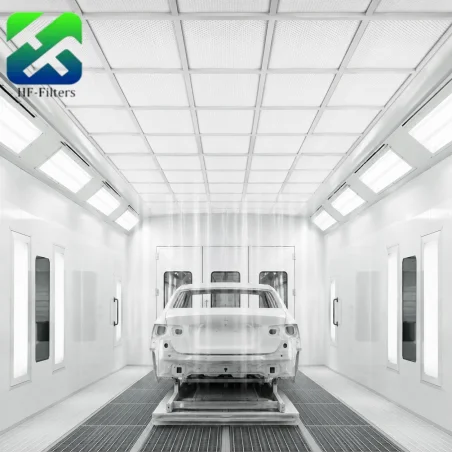
¿Por qué es importante reemplazar el filtro del techo de la cabina de pintura?
El filtro de techo suele ser la última capa de entrada de aire antes de que este entre en la cabina. La base de datos describe el material filtrante del techo de la cabina de pintura como una fibra sintética no tejida para la filtración final, con alta eficiencia de filtración, larga vida útil, alta capacidad de retención de polvo y resistencia a las llamas.
Los filtros de techo comunes para cabinas de pintura F5 tienen especificaciones de referencia como un espesor de 20 a 25 mm, una velocidad de aire nominal de 0,25 m/s, un caudal de aire nominal de 900 m³/h y una caída de presión final de 450 Pa. El HF-600G indica una caída de presión inicial de 30 Pa y una capacidad de retención de polvo de 480 g/m². El HF-560G indica una caída de presión inicial de 25 Pa y una capacidad de retención de polvo de 450 g/m².
Estas cifras le ayudarán a determinar si la cabina funciona con normalidad después de la sustitución.
¿Cuándo se debe reemplazar el filtro de techo de una cabina de pintura?
No se fíe únicamente de las fechas. Una capa gruesa de imprimación, prefiltros deficientes o largas horas de pulverización pueden saturar el filtro del techo más rápidamente. Observe el filtro, el resultado de la pintura y la lectura de presión simultáneamente.
Compruebe la cara del filtro
Sustituya el filtro de entrada de aire del techo si se ve oscuro, roto, húmedo, flácido, obstruido o suelto en el borde. Una pequeña abertura puede permitir que el aire sucio pase por alto el filtro.
Mira el resultado de la pintura.
Las motas de polvo, una corriente descendente débil, un flujo de aire irregular o una pulverización seca pueden indicar problemas con el filtro. La pintura negra lo hace dolorosamente evidente. Las partículas diminutas se ven rápidamente.
Siga la presión diferencial
La caída de presión del filtro de la cabina de pintura aumenta a medida que el polvo se acumula en el material filtrante. Registre la presión diferencial de referencia del filtro limpio después de cada instalación nueva. Reemplace el filtro cuando alcance el límite de la cabina o su valor de resistencia final.
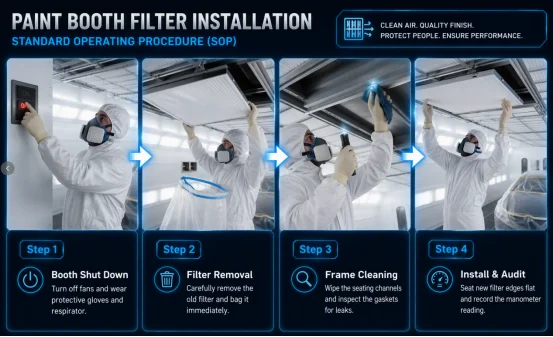
¿Cómo se sigue un procedimiento operativo estándar (SOP) de 4 pasos para la instalación de un filtro de techo en una cabina de pintura?
Un procedimiento operativo estándar (POE) para el reemplazo de filtros en cabinas de pintura garantiza la uniformidad del trabajo. Además, evita que los técnicos se salten los pasos tediosos, que a menudo son cruciales para el acabado.
Paso 1: Apague la cabina.
Apague los ventiladores de suministro y extracción. Espere hasta que cese el flujo de aire. Use guantes, protección ocular y una mascarilla si el filtro antiguo puede contener polvo de pintura.
Paso 2: Retire el filtro viejo.
Sujete el filtro cargado mientras lo retira. No lo agite. No lo arrastre por la cabina. Colóquelo rápidamente en una bolsa y siga las normas locales de eliminación de residuos.
Paso 3: Limpiar el marco.
Limpie el canal de asiento, los clips y la zona de la junta. Compruebe si hay restos de pintura seca, retenedores doblados, juntas faltantes o bordes afilados. El sellado del filtro de la cabina de pintura comienza aquí.
Paso 4, Instalar y grabar
Antes de instalar el filtro, compruebe la dirección del flujo de aire. La mayoría de los filtros de entrada de aire del techo dirigen el aire hacia abajo, pero siga las indicaciones del filtro. Asegúrese de que todos los bordes queden planos. Reinicie la cabina, deje que el flujo de aire se estabilice y registre la lectura del manómetro.
¿Cómo se debe gestionar la presión diferencial en la cabina de pintura?
La gestión de la presión diferencial no tiene por qué ser complicada. Solo necesitas un manómetro, un registro y el hábito de anotar el valor después de cada cambio de filtro.
Establezca una base limpia
Después Instalación de filtro de techo para cabina de pinturaRegistre la lectura de limpieza, la fecha, el tamaño y modelo del filtro, y el nombre del técnico. Si la lectura es mucho mayor que la caída de presión inicial publicada, revise los filtros anteriores, la obstrucción de la entrada, el tipo de medio filtrante o la configuración del ventilador.
Utilice un límite final
Si los datos del filtro de techo indican una caída de presión final de 450 Pa, considérelo una señal de que debe reemplazarlo, a menos que el manual de su cabina especifique un valor más estricto. Un funcionamiento prolongado puede reducir el flujo de aire y desequilibrar la cabina.
Lea atentamente la información sobre la baja presión.
Una lectura muy baja no siempre es buena señal. Puede indicar fugas de aire, un sellado deficiente, la ausencia de una junta o un filtro mal colocado.
¿Qué errores debes evitar?
No instale el filtro al revés. No fuerce un tamaño que parezca aproximado. No reutilice la junta dañada. No omita la limpieza del marco. No cambie solo el filtro del techo sin revisar los prefiltros sucios.
Si el filtro nuevo se llena demasiado rápido, compruebe que el flujo de aire esté completo. El filtro de techo podría estar indicándole otro problema.
Una lente de proveedor práctica para trabajos de reemplazo de limpiadores
La coherencia en los datos del filtro facilita el trabajo de sustitución. Filtros saludables Suministra medios filtrantes, filtros de aire industriales, filtros HEPA y ULPA, filtros de carbón activado y soluciones de filtración a medida. Su gama de materiales para filtros de aire se adapta al mismo tipo de control de entrada de aire que se describe en esta guía.
Para trabajar en cabinas de pintura, la parte útil son los datos prácticos: clase de filtro, velocidad nominal del aire, caída de presión inicial, caída de presión final, espesor y capacidad de retención de polvo. Estos detalles le ayudarán a elegir filtro de techo de cabina de pintura medios, establecer límites de presión y mantener un registro de mantenimiento más preciso.
Preguntas frecuentes
P1: ¿Con qué frecuencia se deben reemplazar los filtros del techo de la cabina de pintura?
A: Reemplácelos cuando la caída de presión alcance el límite establecido, cuando el material filtrante esté dañado o cuando los defectos de la pintura indiquen una filtración de admisión deficiente.
P2: ¿Cuál es la presión diferencial normal para un filtro de techo nuevo?
R: Depende del filtro. Algunos medios filtrantes de techo F5 indican una caída de presión inicial de entre 25 y 30 Pa a una velocidad del aire de 0,25 m/s.
P3: ¿Qué sucede si se instala un filtro de cabina de pintura al revés?
A: El flujo de aire puede volverse irregular, el control del polvo puede disminuir y el filtro puede obstruirse de manera deficiente.
P4: ¿Se puede limpiar y reutilizar el filtro del techo de una cabina de pintura?
R: Normalmente no. El material filtrante final del techo se suele reemplazar, no lavar.
P5: ¿Por qué la presión diferencial es demasiado baja después del reemplazo?
A: Compruebe si hay huecos de derivación, sellado deficiente, medio incorrecto, junta faltante o marco suelto.