
A meeting space can look spotless. Yet, it gets stale by the afternoon. Staff simply zone out. Some gripe about weird scents. Others rub scratchy eyes. This is where indoor air quality meets workplace productivity.
Your core task is quite basic. First, block foul air at its root. Next, push crisp air through the area. Finally, select the proper HVAC air filtration for your setup.

How Are Indoor Air Quality and Workplace Productivity Connected?
Air conditions shift our daily comfort. This alters how easily we tire. It impacts our brain power, too. It even changes how we view a room. Heat and loud noise play a part. Still, clean airflow stands out. You can actually measure it. Then, you can fix it.
Comfort and Focus during the Workday
Poor office air reveals itself easily. A room just feels close. You spot dirt. You catch sour odors. Often, teams just groan about certain spots. A dusty vent is easy to skip on Monday. Come Friday, it demands upkeep. Air might be slipping by. Or, a filter is totally jammed.
One office test checked 24 workers. They worked six full days under different air setups. Researchers changed the ventilation, carbon dioxide, and volatile organic compound levels. The workers’ test scores changed each time. A 2023 meta-analysis of five studies involving 3,679 participants found that higher ventilation rates were associated with faster task performance, while error rates showed a downward trend.
Where Do Dust, Pollen, and Fine Particles Come From?
Tiny specks inside come from the air outside. They also come from things people do indoors. Finding where the dirt comes from helps you pick the right fix.
Office and Commercial Building Sources
Outside dust and pollen blow in. They come through vents, doors, loading docks, and cracks. Things inside add dirt too. Carpets, paper, clothes, cleaning sprays, and printers make dust. Building work adds a lot, too. Air quality drops fast if a desk blocks an air vent.
Big buildings need tough air filtration. Their systems run for a long time. Crowds grow and shrink. Doors open all day. Malls, hotels, airports, and sports arenas usually use two filter stages.
Industrial Sources
Factory air filtration starts with the work itself. Cutting, grinding, mixing powders, painting, and driving trucks make lots of dust. Small vents nearby can trap the mess right away. Then, the main HVAC filters keep the rest of the building clean and safe for machines.
How Do Ventilation and Filtration Work Together?
Moving air and cleaning air do two different jobs. Ventilation brings in fresh outside air. It also pushes out dirty air. Filtration grabs the dirt inside the air pipes.
Ventilation Handles Dilution and Exhaust
Fresh air waters down the bad stuff. This stuff comes from people, furniture, cleaning gear, and machines. Fans pull bad air out of restrooms, kitchens, and workshops. But the fresh air still needs to reach the people. A blocked vent can ruin a great system very quickly.
Filters Clean the Air Stream
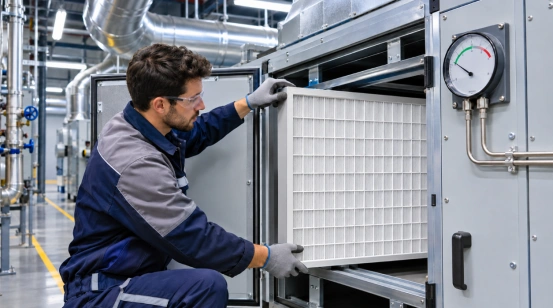
For these tools, a panel pre-filter catches big chunks. Panel pre-filters capture larger airborne particles, helping protect downstream filters. Medium-efficiency filters provide an additional level of particle removal, reducing the dust load on high-efficiency filters. This keeps the next filters safe.
Which HVAC Filter Fits Your Workplace?
Picking a filter depends on a few facts. You must know the dirt type, rated airflow, and pressure-drop limits. You also need to check the space, heat, and wetness. A popular six-pocket size is 592 × 592 × 380 mm. But your machine’s manual tells you if it will truly fit.
Panel and Pocket Filter Stages
You can wash or throw away a panel filter. It works well at fresh-air intakes and first stages. A pocket air filter gives more cloth space. It holds more dirt and catches middle-sized bits. Offices, malls, hospitals, food plants, and tech shops use this setup.
HEPA and Carbon Stages
A HEPA filter for HVAC goes in very clean places. Labs, hospitals, and careful factories use them. H13 and H14 models need tight seals to stop leaks. An activated carbon filter grabs special smells and gases. Its power depends on carbon type, amount, airflow, heat, and dampness.
Check System Fit before Changing the Grade
Thicker filters make it hard for air to pass. The airflow might drop if the fan is weak. Check the starting block and the final pressure-drop limit. Also, check the fan power, rack space, frame shape, and rubber seals. Write down run times and pressure drops. A simple notebook is much better than guessing dates.
A Practical Filter Specification Starts with Real Operating Data
First, learn your dirt and system limits. Then, Filtros saludables can pick the right panel, pocket, HEPA, or carbon stages for you. You can choose custom sizes and frame parts. You also pick cloth types, airflow goals, pressure-drop limits, and seals. This boosts indoor air quality and workplace productivity.
The filter traps the exact dirt while letting enough air flow. Send your use case, size, rated airflow, target grade, pressure-drop limit, and room conditions to get help.
Preguntas frecuentes
Q1: Does indoor air quality affect workplace productivity?
A: Yes it does. Air quality changes comfort and tiredness. It shifts how fresh a room feels and how well you think. Heat, noise, lights, and workload also matter.
Q2: Which filter suits an office HVAC system?
A: Look at the dirt load first. Check the airflow, pressure, and the holding rack. Most systems use a panel and medium-efficiency pocket stages.
P3: ¿Un filtro HEPA elimina los olores?
A: No, HEPA cloth only grabs solid bits. To trap smells, volatile organic compounds, or gases, you need activated carbon or a gas-catching tool.
Q4: Can a higher-efficiency filter reduce airflow?
A: Yes, it can. Air drops if filter drag beats the fan’s push. Read the fan numbers and pressure-drop limits before you switch types.
Q5: What information should you send for a filter quotation?
A: Send the planned use and dirt type. Give the sizes, rated airflow, and wanted grade. Add the pressure-drop limit, frame needs, heat, wetness, count, and any drawings.