
New hospitals, laboratories and biomedical facilities continue to add more controlled spaces in 2026. For HVAC buyers, that raises a practical question: what does a HEPA filter actually need to do in these rooms?
The answer involves more than efficiency.
Size, airflow, initial resistance, sealing and the filtration stages ahead of the HEPA filter can be just as important.

How HEPA Media Captures Particles
HEPA media is a dense network of fine fibers. Particles moving through it can be captured through interception, impaction and diffusion.
That is different from a simple screen.
In a medical HVAC system, however, good media alone is not enough. Air must actually pass through the media rather than leak around the frame or gasket.
This is why filter construction and sealing deserve attention alongside the H13 or H14 rating.
What Does a Medical HEPA Filter Look Like on a Specification Sheet?
Here are examples from Healthy Filters’ current product range:
| Tipo de filtro | Tamaño (mm) | Flujo de aire nominal | Calificación | Caída de presión inicial |
| Deep Pleated HEPA | 484 × 484 × 150 | 530 m³/h | HEPA | <220 Pa |
| Deep Pleated HEPA | 610 × 610 × 150 | 1,000 m³/h | HEPA | <220 Pa |
| Deep Pleated HEPA | 610 × 610 × 220 | 1,600 m³/h | HEPA | <220 Pa |
| Deep Pleated HEPA | 610 × 610 × 292 | 1,700 m³/h | HEPA | <220 Pa |
| V-Bank HEPA | 287 × 592 × 292 | 1,200 m³/h | H13/H14 available | 250 / 280 Pa* |
| V-Bank HEPA | 592 × 592 × 292 | 2,700 m³/h | H13/H14 available | 250 / 280 Pa* |
*H13/H14 initial resistance respectively. Specifications are product examples rather than universal values; final selection should be matched to the HVAC system and project requirements.
H13 or H14?
Under EN 1822 classification, H13 and H14 are not interchangeable labels.
H13 is rated at ≥99.95% MPPS efficiency, while H14 reaches ≥99.995% at MPPS.
But choosing H14 simply because the number is higher is not always the right approach.
A higher-efficiency configuration can affect resistance and available airflow. The HVAC system still has to deliver its required volume of air.
That trade-off becomes especially relevant when filters operate continuously.
Where Does HEPA Actually Belong?
Not every hospital room needs HEPA filtration.
Selected operating environments, laboratories, controlled preparation rooms and other sensitive spaces may call for high-efficiency final filtration. General corridors or waiting areas can have different requirements.
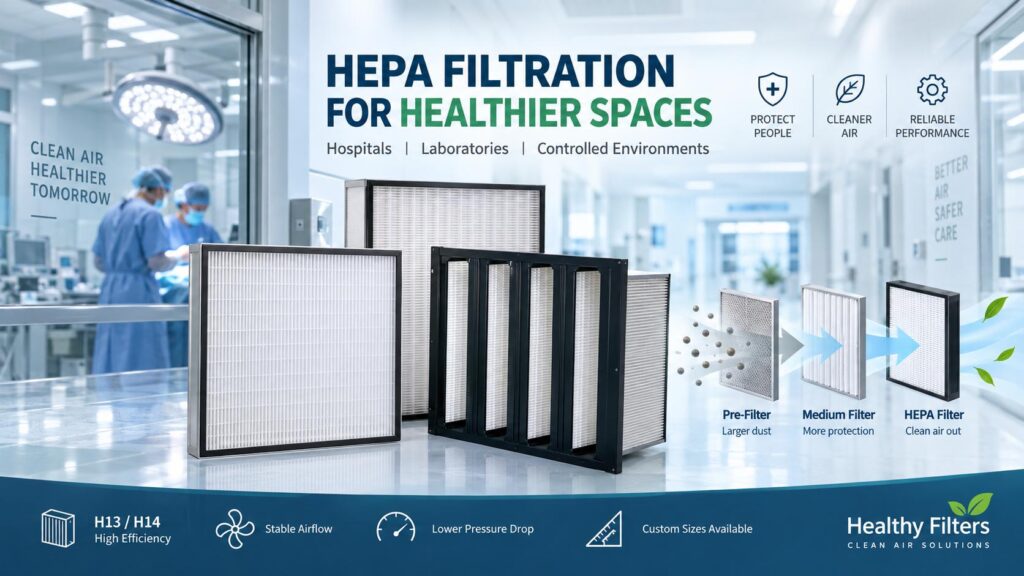
Where HEPA is used, it is often the last part of a staged system:
Pre-Filter → Medium-Efficiency Filter → HEPA
The first stages remove larger dust before it reaches the HEPA media. That can reduce loading on the final filter and make the system easier to manage.
Pressure Drop Is a Buying Parameter, Not Fine Print
Take a 610 × 610 mm filter as an example.
Changing the depth and media configuration can change how much air the filter handles and how much resistance it creates. Two filters with similar face dimensions may therefore behave very differently inside an air-handling unit.
When comparing quotations, buyers should check at least:
size + efficiency grade + rated airflow + initial pressure drop + frame + gasket/sealing
Comparing only “H13 versus H14” leaves out much of the engineering picture.
Where Healthy Filters Fits
Healthy Filters fabrica H13/H14 HEPA, deep-pleated HEPA, V-Bank HEPA, pre-filters and general ventilation filters for HVAC and controlled-environment projects.
More importantly for B2B projects, the filter does not have to stop at a catalog size.
Dimensions, media, efficiency, rated airflow, pressure drop, frame construction and gasket configuration can be adjusted for OEM/ODM requirements. That is useful when replacing an existing filter, matching an AHU specification or developing filtration for new equipment.
For a hospital or laboratory project, the starting point can therefore be very concrete: send the required W × H × D, filter grade, airflow and allowable pressure drop. From there, the filter construction can be matched to the application.
Need H13/H14 HEPA filters for a hospital, laboratory or HVAC project? Contact Healthy Filters with your dimensions, airflow and efficiency requirements for standard or customized filter options.
Preguntas frecuentes
¿H14 siempre es mejor que H13?
Not automatically. H14 provides higher MPPS efficiency, but airflow, resistance and the actual room requirement also need to be considered.
What is a common industrial HEPA filter size?
610 × 610 mm face dimensions are common in industrial HVAC applications, with several depths available. Actual sizes should always be checked against the housing.
Why does HEPA filter pressure drop matter?
Higher resistance increases the load on the HVAC fan and can affect airflow. It should be evaluated at the specified operating airflow.
Can Healthy Filters manufacture non-standard HEPA sizes?
Yes. Healthy Filters supports customized dimensions, media, efficiency, airflow, pressure drop, frames and sealing configurations for OEM/ODM and project requirements.