
A primary air filter looks simple. Some buyers even call it “just the first layer.”
But in real factories, this first layer decides how stable the whole filtration system will be.
We have seen many workshops replace HEPA filters too often, not because the HEPA filter quality was poor, but because the primary filter was missing, too thin, or selected with the wrong MERV rating.
What does a primary air filter do?
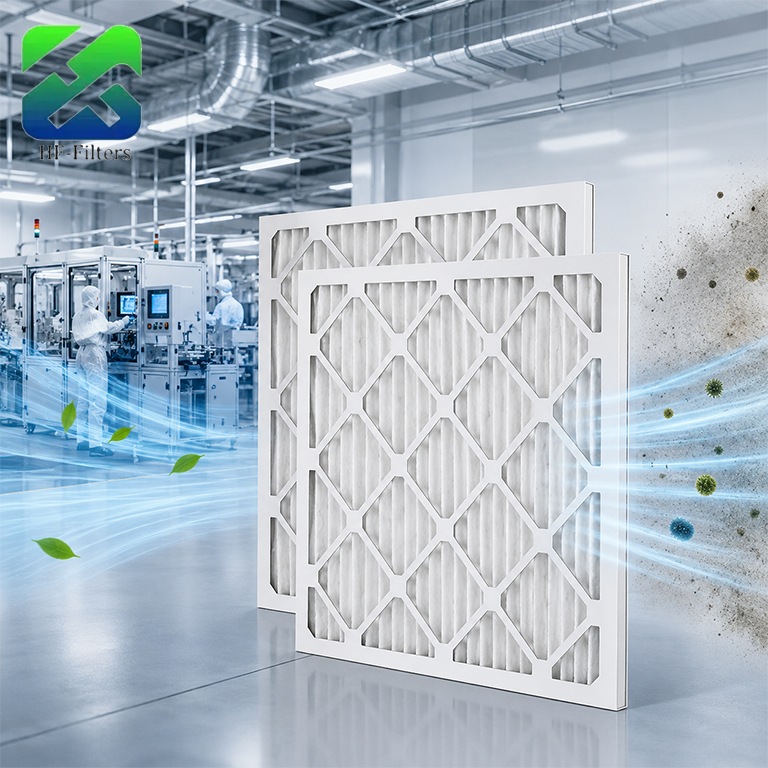
A primary air filter captures larger dust before the air reaches medium-efficiency filters, HEPA filters, activated carbon filters, or industrial dust removal units.
In most manufacturing plants, the first-stage filter handles:
- Large dust
- Fiber particles
- Hair and lint
- Packaging dust
- Metal or plastic processing particles
- Outdoor coarse particles from fresh air intake
Its job is not to remove 0.3 micron particles. That is the work of H13/H14 HEPA filter products.
The primary filter protects the expensive filters behind it and keeps system resistance more stable.
Why it matters in manufacturing plants
It protects downstream filters
In electronics, packaging, plastics, furniture, food processing, and HVAC make-up air systems, dust load is often higher than expected.
If large particles enter directly into a HEPA filter, the pressure drop rises fast. The filter may still have good efficiency, but airflow becomes weak.
That means higher energy cost, shorter filter life, and more frequent shutdowns.
It keeps airflow more stable
For manufacturing, stable airflow is not a small detail.
When airflow drops, ventilation balance changes. Clean zones may lose pressure. Dust collection points may not capture properly. In some HVAC air filter systems, operators only notice the issue when the workshop already feels stuffy.
A good primary filter helps delay this problem.
It reduces total replacement cost
One factory buyer once told us their H14 medical filter section was being replaced too often. After checking the system, the issue was not the H14 filter.
The pre-filter stage had poor dust holding capacity.
After changing to a thicker pleated primary filter with better media area, the HEPA filter service life became much more stable.
How to choose a primary air filter
For most industrial ventilation systems, primary filters are commonly selected around MERV 5–8, depending on dust level and airflow.
For heavier dust conditions, buyers should check three things carefully:
- Dust holding capacity
- Initial pressure drop
- Frame strength
- Media thickness
- Installation sealing
At Healthy Filters, we usually ask customers for airflow, filter size, dust type, and replacement cycle before recommending a structure. A cheap flat panel filter may work in a light-duty office HVAC unit, but it may fail quickly in a real workshop.
Different manufacturing scenarios
Electronics and cleanroom support areas
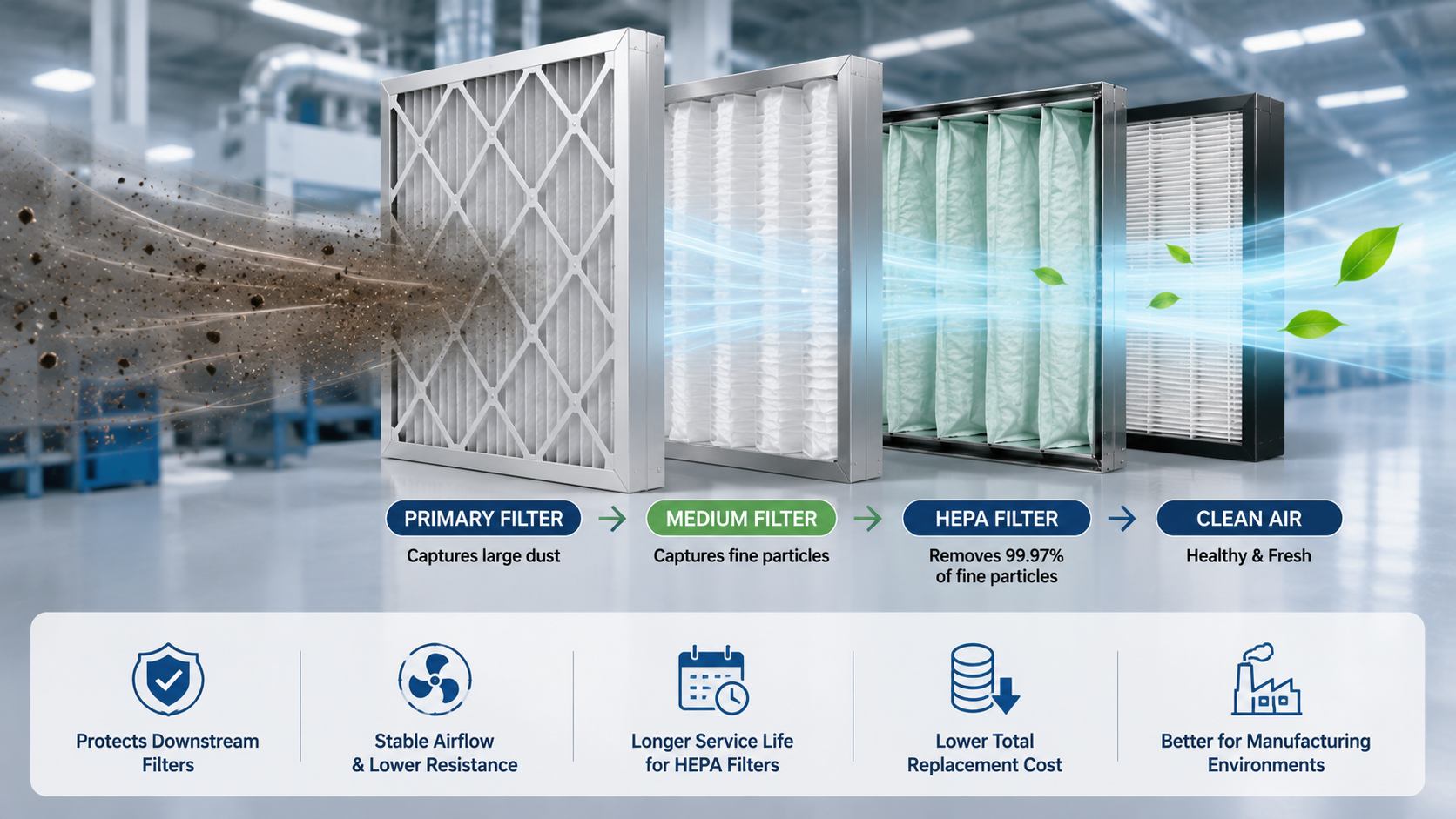
These areas often use a staged system: primary filter, medium filter, then HEPA filter.
The primary filter removes larger particles first. The HEPA filter handles fine particles at the final stage.
For cleaner zones, leakage control and frame sealing are important. Healthy Filters uses ultrasonic hot-melt sealing, low-resistance media design, and PAO leak testing for suitable high-efficiency filter products.
Metalworking and machinery workshops
Metal dust, oil mist, and grinding particles can load filters quickly.
A stronger primary filter or washable pre-filter may be used before the main industrial air filter section. The goal is not only filtration efficiency, but also longer service life and easier maintenance.
Food, packaging, and general factories
These sites often deal with fibers, paper dust, plastic dust, and outdoor particles.
A primary filter with good dust holding capacity can reduce clogging and protect bag filters or activated carbon filters behind it.
Healthy Filters produces primary filters, medium-efficiency bag filters, HVAC air filter products, industrial dust removal filter elements, activated carbon filter products, and custom HEPA air filter solutions for different factory systems.
Common buying mistakes
Do not choose only by price.
A very thin primary filter may look cost-saving, but if it clogs quickly, the real cost becomes higher.
Do not choose only by MERV rating either. A higher MERV rating may increase initial resistance if the media area is not enough.
Also check whether the frame can handle the airflow. In industrial systems, weak cardboard frames may deform under high air volume or humid conditions.
For OEM and project buyers, Healthy Filters can customize size, thickness, frame material, media grade, LOGO, and packaging. Our Shenzhen factory has a 10,000㎡ workshop, automated production lines, and monthly capacity of 500,000+ filter elements.
When should primary filters be replaced?
There is no single replacement cycle for every factory.
In light HVAC systems, primary filters may last 1–3 months. In dusty workshops, they may need replacement much sooner.
The better way is to check:
- Pressure drop
- Dust load
- Airflow change
- Visual clogging
- Production environment
- Downstream filter condition
If the primary air filter is fully clogged, the system fan works harder and the filters behind it may not perform as designed.
Preguntas frecuentes
What is a primary air filter?
A primary air filter is the first-stage filter used to capture large dust and protect medium filters, HEPA filters, activated carbon filters, and HVAC systems.
What MERV rating is used for primary filters?
Many primary filters are around MERV 5–8. The right grade depends on dust level, airflow, pressure drop limit, and system design.
Can a primary filter replace a HEPA filter?
No. A primary filter removes large particles. A HEPA filter removes fine particles. H13/H14 HEPA filters are used for higher-efficiency filtration.
Why is dust holding capacity important?
Higher dust holding capacity helps the filter last longer before pressure drop becomes too high. This is very important in manufacturing workshops.
How often should industrial primary filters be changed?
Light-duty HVAC systems may replace them every 1–3 months. Dusty factories should check pressure drop and airflow more often.
Can Healthy Filters customize primary air filters?
Yes. Healthy Filters can customize filter size, frame, media grade, thickness, logo, and packaging for HVAC contractors, industrial buyers, and OEM brands.
Need help with filter selection?
Send your filter size, airflow, dust type, pressure drop limit, and working environment to Healthy Filters.
Shenzhen Healthy Filters Co., Ltd. can review your application and provide a practical filter structure, sample plan, or custom quotation within 72 hours.